How buying and selling cards works on AllCardzz
AllCardzz is a marketplace for sports and trading cards where every trade passes through a partner counter — a real shop, with a person in it, who looks at the card before any money moves. You pay at checkout and AllCardzz holds the money; the seller is paid after you have the card in your hands.
That one difference is what the rest of this page is about: the buyer’s route from search to card in hand, the seller’s from shoebox to paid, and what the counter in the middle actually does.
For buyers — from search to card in hand
1. Find the card, and pick the copy
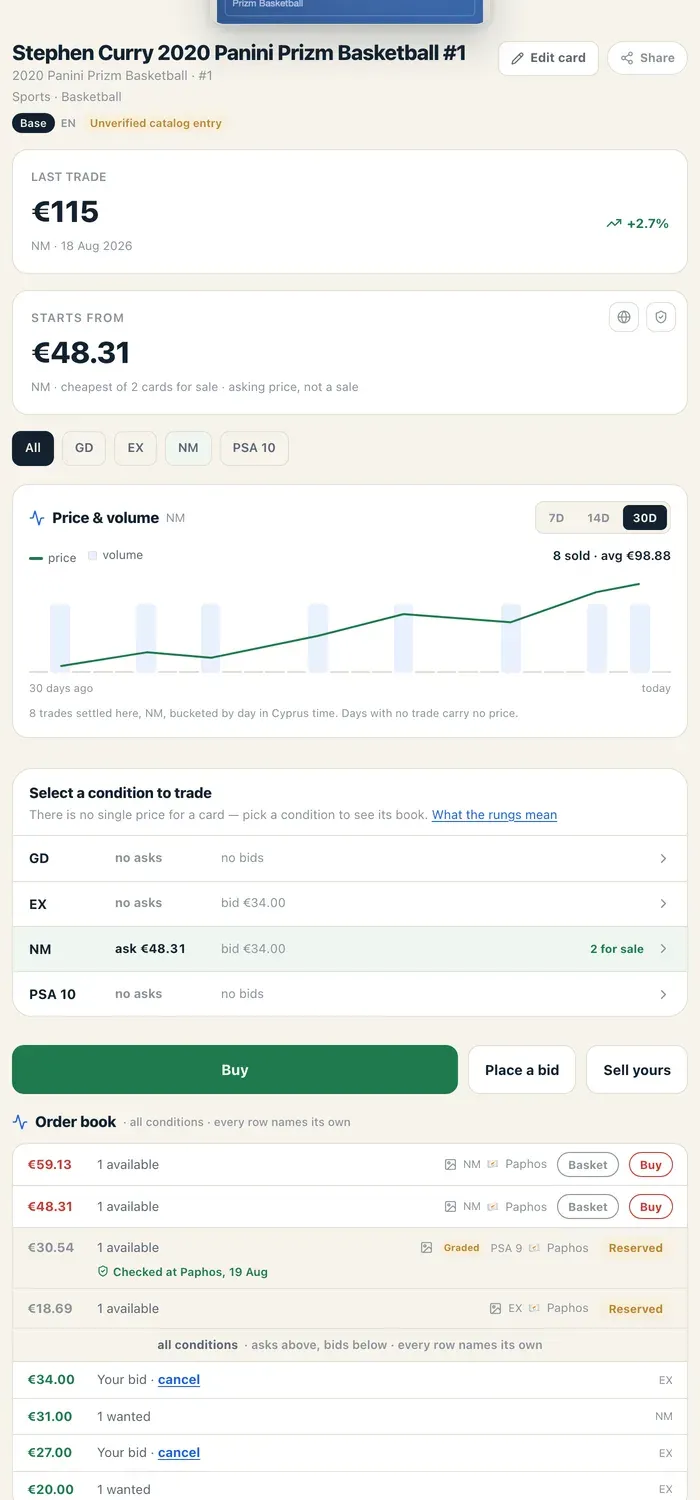
Search the catalog, follow what is trending, or read somebody’s public binder. A card page is not one price: each printing and each condition is its own market, so a Near Mint copy and a Good one never share a number, and a graded slab never averages into either.
2. Read the book — asks on one side, bids on the other
Sellers post asks. Buyers post bids saying what they would pay, against a particular condition or grade. Both sit side by side with the spread between them, next to what the last copy actually sold for. You can buy at an ask, or place a bid and wait — a seller is free to accept a bid below their own asking price, and the accept is a real path in the product rather than a formality. How prices work here →
3. Pay — and the money stops there
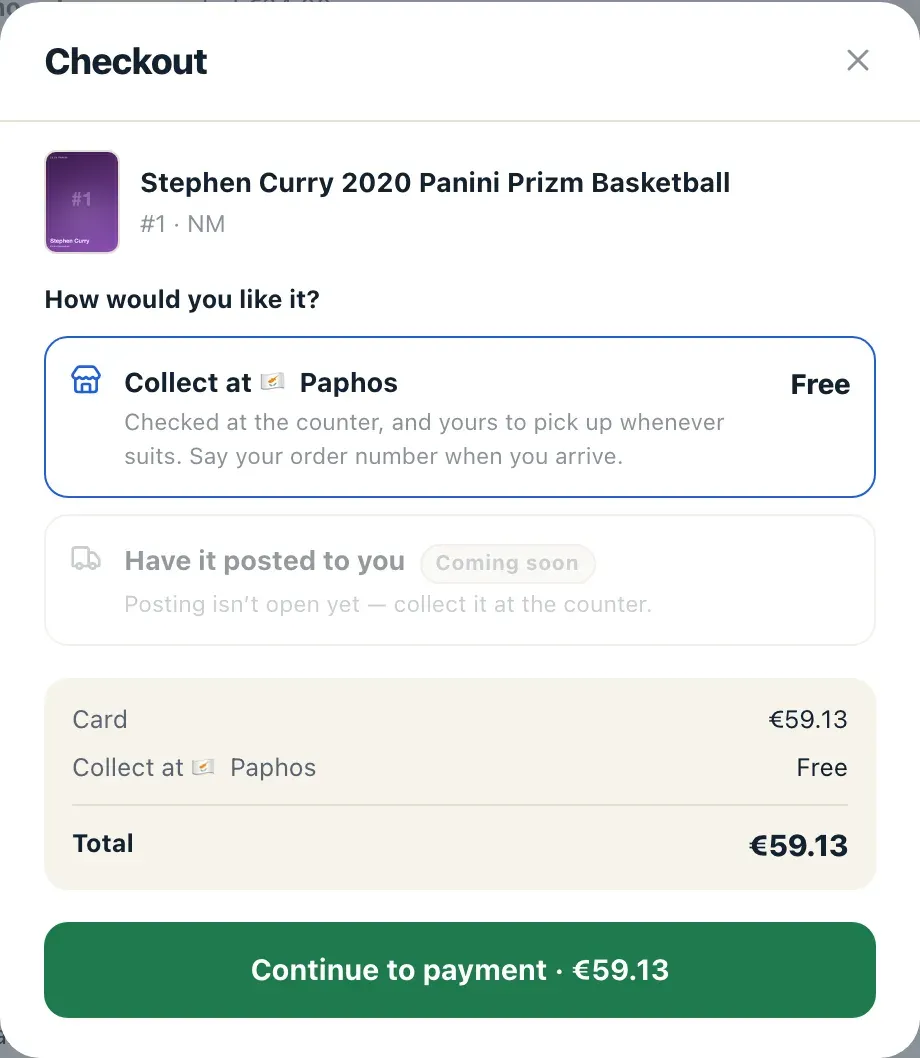
You pay at checkout by card, and the money goes to AllCardzz rather than to the seller. They cannot touch it, and there is no step in which somebody is trusted to post a card they have already been paid for. The checkout names the counter you will collect from and prices the collection at nothing.
4. Watch it come in
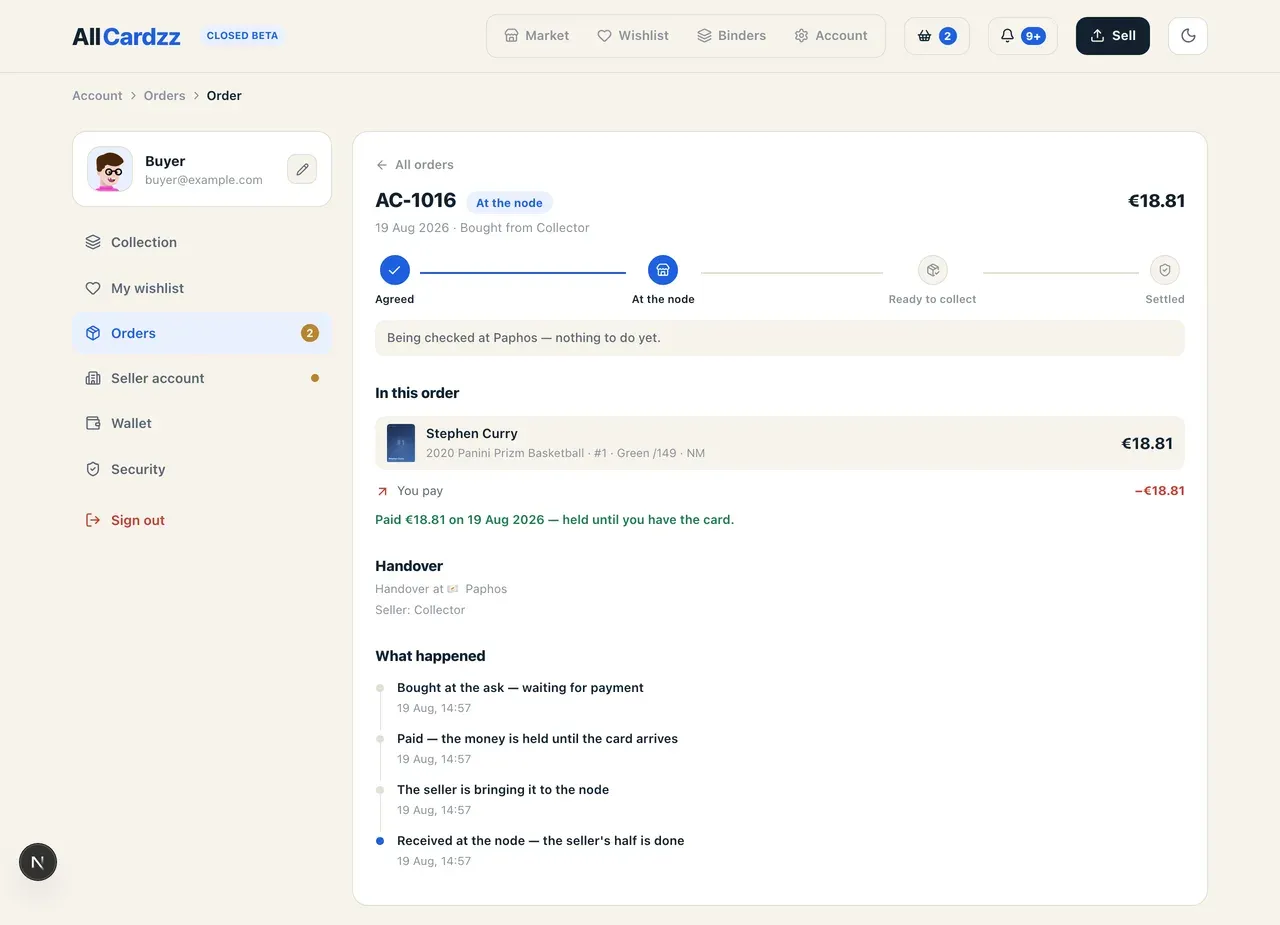
Your order page carries the whole clock. The seller has 48 hours to say how the card reaches the counter — brought in, or posted with a tracking number — and if they are bringing it, a further seven days to do it. Every deadline is printed with the date it falls, and a missed one cancels the order and refunds you without your having to ask for it.
5. Collect it, and the seller gets paid
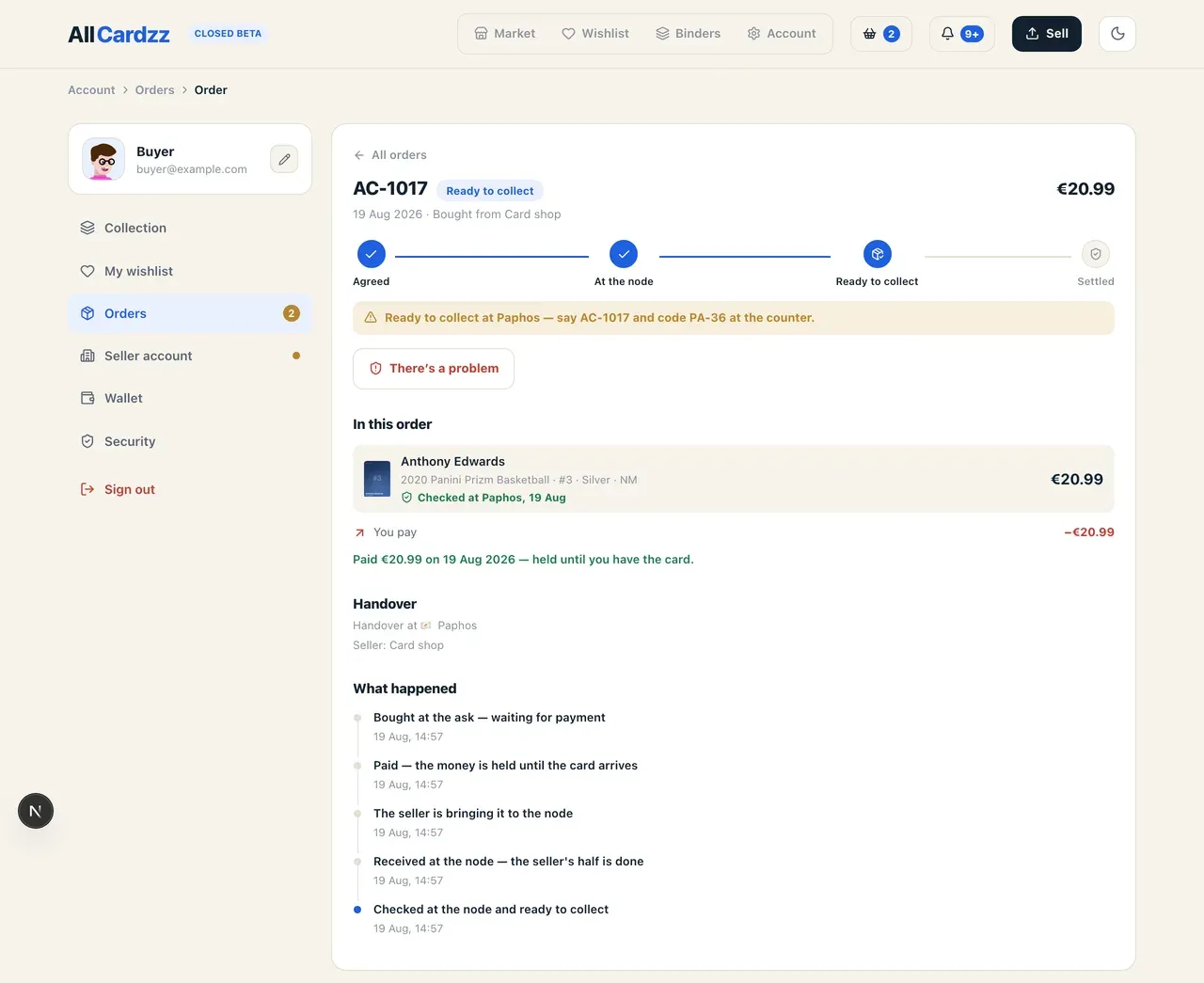
When the counter has received the card and it has passed its check, you are told it is ready — and the 21 days you have to collect start there. At the desk you give your order number and either read out your collect code or show photo ID. The card changes hands, the order settles, and the payout to the seller is released — in that order, never the other way round.
For sellers — from shoebox to paid
1. Add the card
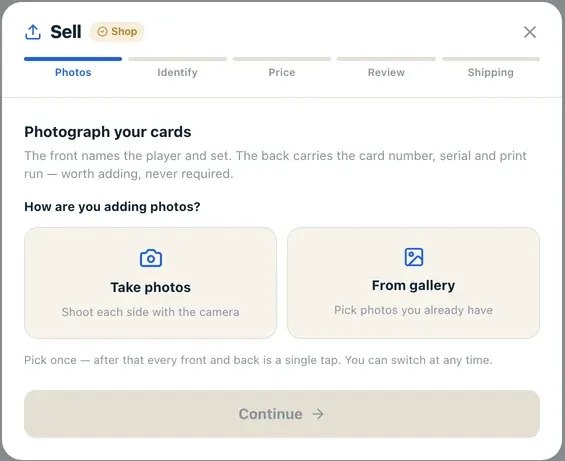
Four steps — photos, identify, price, review. Photograph the front and let the wizard match it against the catalog, or find the printing yourself; the back is worth adding for the card number and the serial, and the wizard asks for it without requiring it. You declare the condition — one of seven raw rungs, or a slab with its grading company, grade and certificate number — and set your price. Listing costs nothing, and an ask does not expire.
2. Pick the counter it will be handed over at
You choose it when you list. It is where your card goes when the copy sells, and where the buyer will collect it. See the counters →
3. When it sells: bring it in, or post it tracked
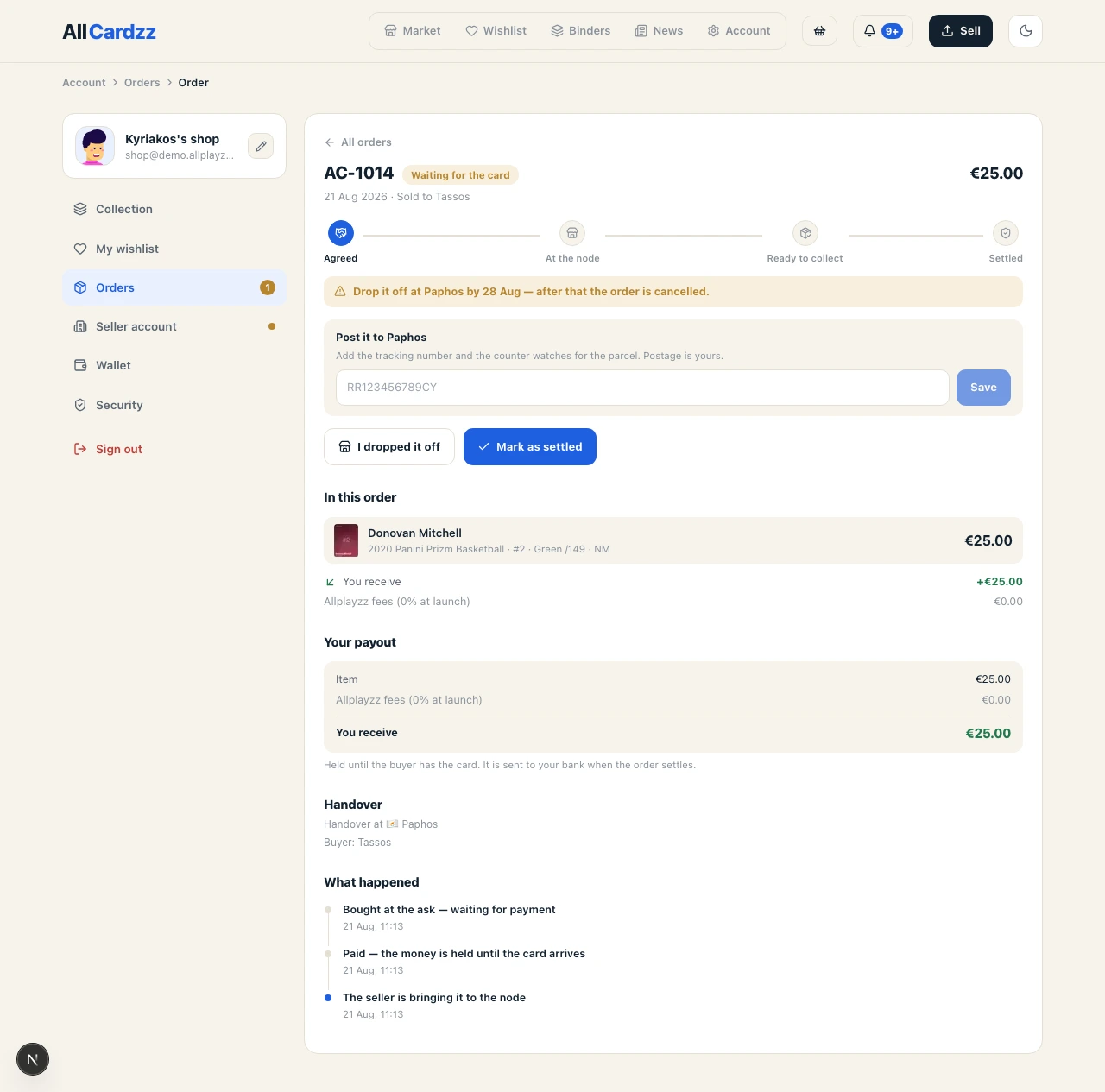
You have 48 hours to say which. Bringing it in gives you a week to make the trip. Posting means a tracking number, registered on the order so the counter can watch the parcel — there is no untracked option, and the postage is yours. Either way, the buyer’s money is already sitting with us.
4. The counter presses Received — and your part is done
That press is the moment your obligation ends. What happens next — the check, the buyer coming in, the identity check at the desk — is between the counter and the buyer.
5. Get paid
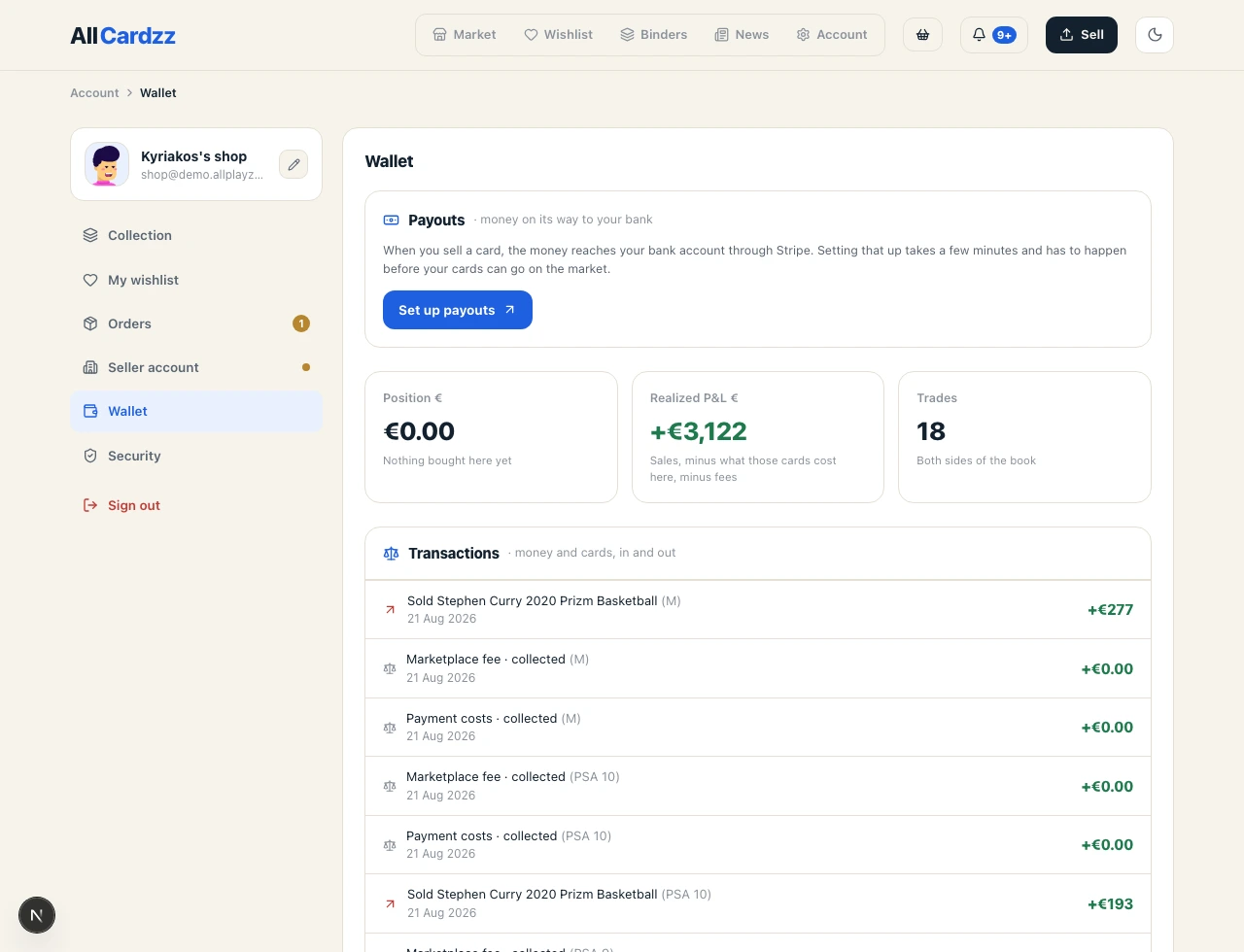
Money from cards that have sold but not yet changed hands shows as Held in your wallet. When the buyer has the card it is transferred to your own Stripe account and becomes Available, on its way to your bank on the next payout. The selling fees are 0% at launch, so nothing comes off the proceeds — they are still itemised on the order page at €0.00 and still posted to the wallet ledger as rows of their own, which is where you will see it the day that changes.
Why the counter matters — the operator node explained
A counter is a partner shop that has agreed to stand in the middle of other people’s trades. It is the part of AllCardzz with no equivalent on a marketplace where a card goes straight from a stranger’s envelope into yours, and it is doing four specific jobs.
A human checks the card before money moves
The operator compares the card against what the seller declared and records a verdict — pass or fail, one card at a time, with photographs on file when it fails. A failure opens a case there and then, while the money is still held. Nobody is chasing a refund after the fact.
Custody is logged
Received, checked, handed over — each one a timestamped entry on an order timeline that the buyer and the seller both read, from the same source and with no filter between them. There is no version of events only one side can see.
Nobody is paid until the buyer has the card
Your payment is held by AllCardzz from checkout onwards, and the payout is a separate step that fires after the hand-over. A collection at the counter settles on the spot; a parcel posted onward instead settles after 48 hours in which you said nothing — so there is always a window in which to speak up, and a button on the order to speak up with.
A local place to go
You collect in person, during opening hours, with a collect code or photo ID at the desk. If a card has to go back, it goes back to the same counter, to the same people, who already have it on record.
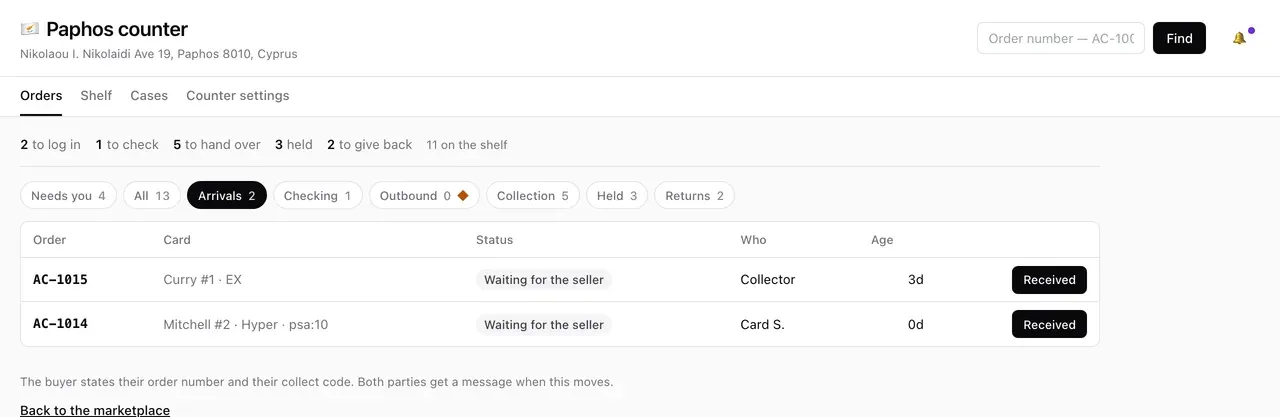
None of that is a policy document. It is a queue an operator works through, and a trail it leaves behind — and that trail is the same one you read on your order.
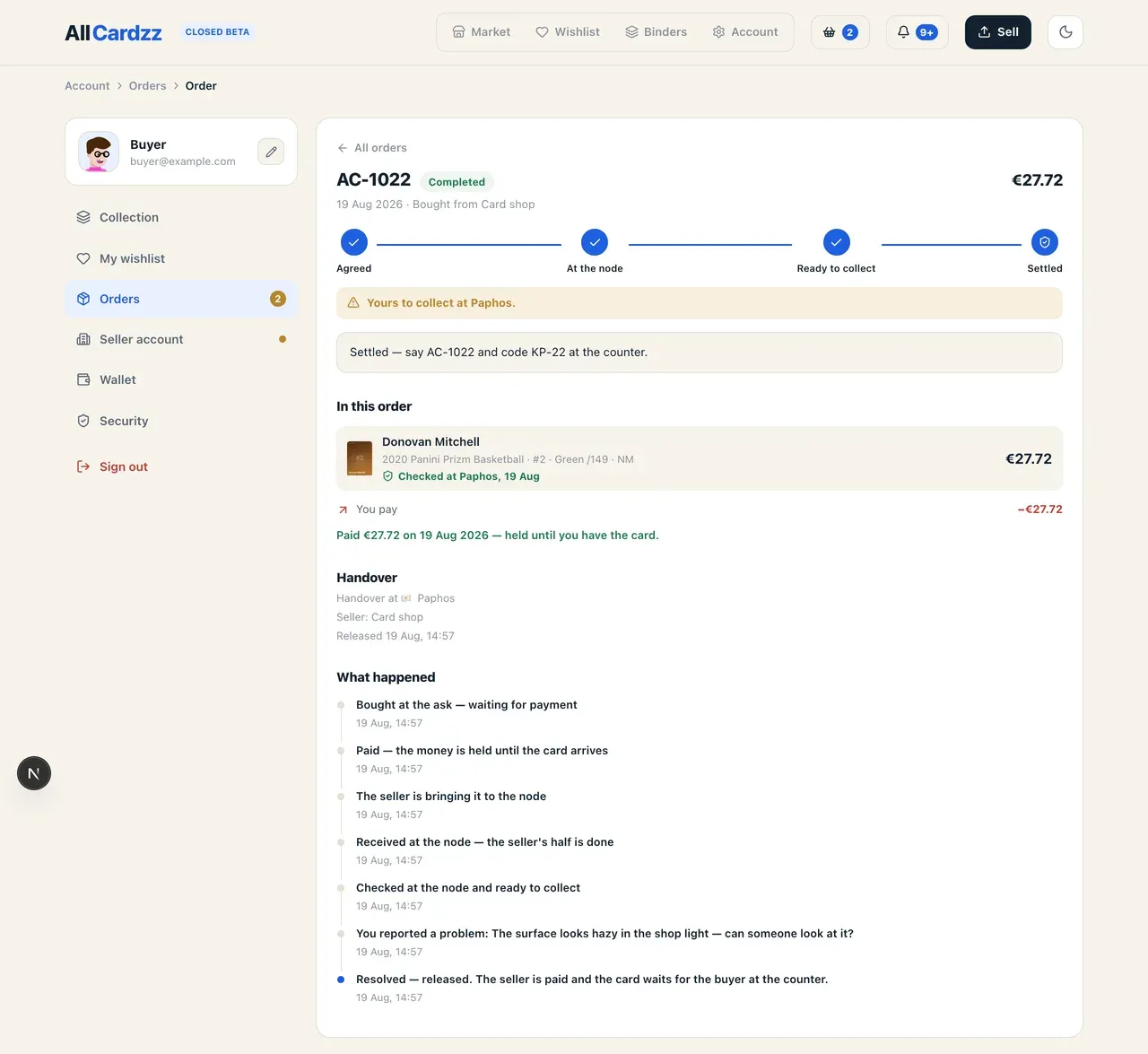
Safe and transparent by design
- Your money is held by AllCardzz until the hand-over. Not sent to the seller and clawed back if something goes wrong — never sent in the first place.
- A check before release, not after a complaint. The card is looked at by somebody with no stake in the sale, and their verdict is on the order.
- Every step is timestamped, and both sides read the same one. One timeline, one set of facts, no privately-held version of events.
- Missed deadlines act on their own. If the seller does not say how the card travels within 48 hours, or does not bring it in within the week, the order is cancelled and you are refunded without your having to ask. If they posted it and it never turns up, It never arrived opens on your order after seven days — press it and the money stays where it is until somebody has looked.
- Five doors when something is wrong. Not as described · It never arrived · Damaged in transit · Wrong card · Something else. Opening one pauses the clocks, and the outcome is a release, a refund, or a return handed back at the same counter.
- Honest price labels. An ask is marked as an asking price and not a sale, a last trade is a trade that happened, and an estimate is labelled as an estimate with the confidence behind it. Raw and graded prices are never blended, and the chart refuses to draw a line where there are no trades to draw it from.
- The seller’s fee is shown where the money is. It is itemised on the order page and posted as a row of its own in the wallet ledger, in euro — at launch, €0.00.
What it costs
Sell with 0% fees at launch. Keep 100% of every sale — no commission, no payment costs. 30 days’ notice before that ever changes.
| What | Who pays | How much |
|---|---|---|
| Listing a card | Seller | Free |
| Marketplace fee on a sale | Seller | 0% at launch |
| Payment costs | Seller | 0% at launch — we cover them |
| Platform fee for buying | Buyer | None |
| Collecting at the counter | Buyer | Free |
The seller’s fees come out of the proceeds rather than being added to what the buyer pays, and are drawn on the order page once the sale completes — at launch, one line reading €0.00. It is an introductory rate: any future fee will be announced at least 30 days in advance, and would apply only to sales made after the change, never to a sale already agreed. Postage to the counter is the seller’s own cost, not a fee we take.
Questions
What does it cost?
Nothing at launch, for either side. Listing a card is free, buyers pay no platform fee, and collecting from the counter costs nothing — and selling is 0% at launch: no commission, and we cover the card-processing costs, so a seller receives exactly the sale price. This is an introductory launch rate; any future fee will be announced at least 30 days in advance and would apply only to sales made after the change. The fee line stays on the order page at €0.00 so you can see it for yourself.
Do I have to use a counter?
Yes — every card sold here is handed over at the counter named on the listing. The seller either brings it in or posts it there with a tracking number, and the buyer collects it in person for nothing. Having a card posted to a home address is not open yet, and the checkout says so rather than taking the order.
How long does a trade take?
The seller has 48 hours after payment to say how the card travels, and if they are bringing it in, a further seven days to make the trip. Once the counter has checked it you are told it is ready, and the 21 days you have to collect start from that moment. Every one of those deadlines is printed on your order page with the date it falls, and reporting a problem pauses them.
Which currency?
Euro, everywhere — every price on the site, every bid, and every payout. There is no currency switcher, and no conversion happening quietly behind one.
More of them in Help & FAQ, and the words in the glossary.